
Fix a dripping tap is one of the most common plumbing problems found in homes. At first, the sound of a drop falling into the sink may seem like a minor irritation. However, a tap that continues dripping can indicate a worn internal component, a damaged seal, a faulty cartridge or another plumbing issue that needs attention.
The correct way to deal with a dripping tap is to identify where the water is coming from and understand why the tap is not closing properly. Different types of taps use different internal mechanisms, so the appropriate repair depends on the design and condition of the fitting.
This guide explains the common reasons for a dripping tap, how the problem can be investigated and what solutions may be suitable.
Why Is My Tap Dripping?
A tap usually drips because water is still passing through the internal mechanism when the tap is supposed to be closed.
Several components can cause this problem. Traditional taps may have washers that wear down with use, while modern mixer taps commonly use cartridges. Seals and O-rings can also deteriorate over time.
Mineral deposits can affect moving parts and sealing surfaces, particularly when a tap has been used for many years. A damaged valve or another internal component can also prevent the tap from shutting off correctly.
The visible dripping is therefore a symptom. The actual cause needs to be identified before the right repair can be selected.
Common Causes of a Dripping Tap
Worn Tap Washer
A worn washer is a common cause of dripping in traditional taps.
The washer helps create a seal when the tap is closed. After repeated use, it can become compressed, damaged or worn. When this happens, a small amount of water may continue to pass through the fitting.
Replacing the worn washer can resolve the issue when the rest of the tap remains in good condition.
Damaged Cartridge
Mixer taps often use cartridges rather than traditional washers.
A cartridge controls water flow and, in many mixer taps, the temperature as well. If the cartridge becomes worn or damaged, the tap may continue dripping even when the handle is in the closed position.
Other signs can include a stiff handle, difficulty controlling the temperature or inconsistent water flow.
If the cartridge is responsible, it may need to be replaced with a compatible component.
Worn O-Ring or Seal
Seals and O-rings are used in different areas of a tap to prevent water escaping from joints and moving parts.
An ageing seal can become hard, cracked or deformed. This can allow water to escape around the handle or base of the tap.
A damaged seal may be relatively small, but it can cause persistent moisture around the fitting.
Mineral Deposits
Mineral deposits can build up inside plumbing fixtures over time.
These deposits can affect the operation of valves, cartridges and other moving parts. They may prevent a component from creating a proper seal, resulting in dripping or difficulty operating the tap.
If deposits have caused significant damage to the internal mechanism, replacing an affected component may be necessary.
Loose or Damaged Components
A component inside the tap may become loose or damaged through regular use.
A loose fitting can affect how the internal mechanism operates, while a damaged component may prevent the tap from closing completely.
This is why simply tightening the tap handle is not necessarily a solution. The internal cause needs to be established first.
Different Types of Dripping Tap Problems
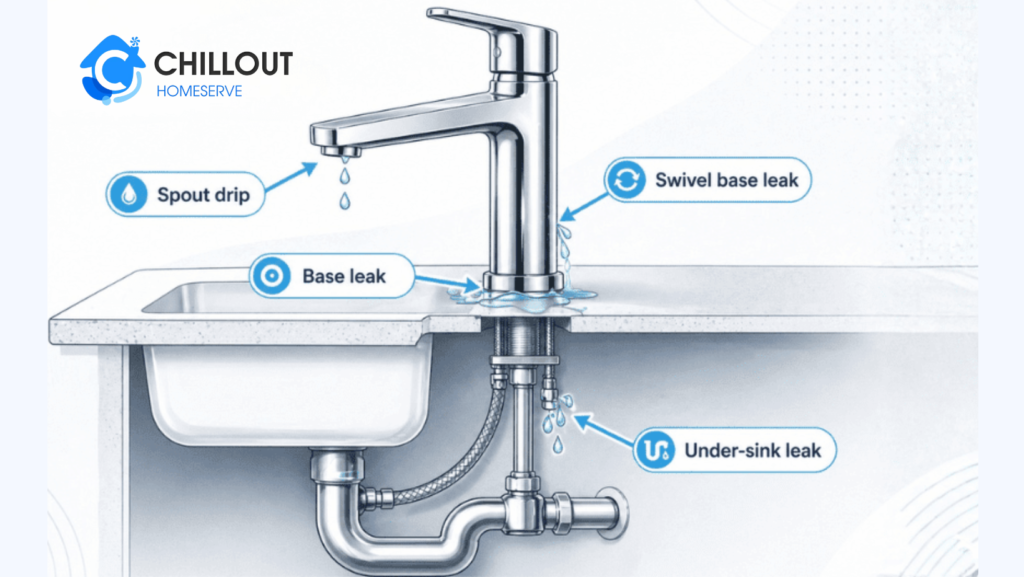
The location of the drip can provide useful information.
A tap that drips continuously from the spout after being closed often has an issue with its internal valve, washer or cartridge.
Water appearing around the handle can indicate a seal or cartridge problem.
If water is collecting around the base of the tap, the problem may involve a seal or the connection between the tap and sink.
Water underneath the sink may have a different source altogether. It could be coming from a flexible supply hose, connection, isolation valve or another part of the plumbing system.
Identifying the location of the water is therefore an important part of the investigation.
How Is a Dripping Tap Diagnosed?
Before carrying out a repair, the plumbing fitting should be inspected to establish the source of the problem.
The tap can be checked while it is open and closed to see when the water appears. The handle, spout, base and visible connections can then be examined.
For mixer taps, the cartridge and related components may need to be assessed. Traditional taps may require inspection of the washer and valve mechanism.
If water is appearing underneath the sink, the supply connections and surrounding pipework should also be checked.
The purpose of this inspection is not simply to stop the visible drip. It is to identify the component responsible for the leakage.
What Is the Solution for a Dripping Tap?
The solution depends on the cause.
If a worn washer is responsible, replacing the washer may restore the seal and stop the dripping.
If a mixer tap has a damaged cartridge, the cartridge may need to be replaced with the correct type.
A worn O-ring or seal can also be replaced when the remaining components are in suitable condition.
Where mineral deposits have affected internal parts, the affected components may need inspection and replacement depending on their condition.
If the tap body itself is damaged, badly corroded or heavily worn, replacing the complete fitting may be more practical than repairing individual parts.
After the repair, the tap should be tested to make sure it closes correctly and that no water is escaping from the spout, handle, base or connections.
When Does a Dripping Tap Need Replacement?
Not every dripping tap needs to be replaced.
A simple internal component may be enough to resolve the problem when the tap body and other parts are still in good condition.
Replacement may become more suitable when the tap has several faults, the body is damaged, internal components are severely worn or suitable replacement parts are difficult to obtain.
An older tap that has required repeated repairs may also be worth assessing for replacement rather than continuing to address individual failures.
The decision should be based on the condition of the complete fitting rather than the dripping alone.
Can a Dripping Tap Cause Water Damage?
A small drip from the spout is unlikely to cause major structural damage on its own, but leaks around the base or underneath a sink can be more concerning.
Water that repeatedly reaches a cabinet, worktop or surrounding material can contribute to staining, swelling and moisture problems.
A leak from a connection can also become worse over time.
This is why a persistent leak should be investigated rather than ignored simply because the amount of water appears small.
What If the Tap Stops Dripping but the Problem Returns?
If a tap stops dripping temporarily and the problem returns, the original cause may not have been fully addressed.
For example, replacing one component may not resolve an underlying issue with another internal part. Mineral deposits, damaged valve surfaces or general wear can also contribute to recurring problems.
Repeated leakage is a reason to inspect the complete tap rather than continuing to treat the symptom.
Dripping Tap or Hidden Plumbing Leak?
It is also important to distinguish a dripping tap from a hidden plumbing leak.
If the visible drip comes directly from the spout, the tap mechanism is a likely starting point for investigation.
However, if there is unexplained moisture around the sink, wall, cabinet, floor or ceiling, the source may be elsewhere.
A hidden pipe leak can sometimes travel away from its original source before becoming visible. In such cases, leak detection or moisture investigation may be required to identify where the water is coming from.
How to Prevent Tap Problems
Regular observation can help identify tap problems at an early stage.
Pay attention to changes such as a tap becoming difficult to operate, water appearing around the handle, a slow drip after closing or moisture around the base.
Avoid forcing a stiff handle because excessive pressure can place additional stress on the internal mechanism.
It is also useful to check the plumbing connections underneath sinks from time to time. Early signs of moisture can be easier to deal with before surrounding materials are affected.
When Should You Contact a Plumber?
A plumber can be helpful when the source of the leak is unclear, the tap cannot be shut off properly, water is leaking underneath the sink or the problem continues after a repair.
Professional inspection is particularly useful when the tap is part of a larger plumbing issue. What looks like a leaking tap may sometimes be connected to a faulty valve, damaged supply connection or another plumbing problem.
If there is significant water leakage or water is reaching electrical fittings, the situation should be treated as a priority and the appropriate safety measures taken.
Frequently Asked Questions
Why does my tap keep dripping after I close it?
A worn washer, damaged cartridge, faulty valve or deteriorated seal can prevent the tap from closing completely. The exact cause depends on the type of tap.
Why is my mixer tap dripping?
A worn cartridge or damaged internal seal is a common reason for a mixer tap to continue dripping. The cartridge and other internal parts should be checked.
Can a dripping tap be repaired?
Yes, many dripping taps can be repaired by replacing a worn washer, cartridge, seal or another faulty component. The condition of the complete fitting should be considered.
Why is my tap leaking around the handle?
Water around the handle can indicate a worn cartridge, O-ring or internal seal. The tap needs to be inspected to identify the specific cause.
Should I replace an old dripping tap?
Replacement may be appropriate if the tap is badly worn, damaged or repeatedly develops faults. If only one internal component has failed and the fitting is otherwise in good condition, repair may be sufficient.
Conclusion
A dripping tap is usually a sign that an internal component is no longer creating a proper seal. The cause could be a worn washer, damaged cartridge, deteriorated O-ring, mineral deposits or another faulty component.
The most suitable solution depends on the type of tap and the condition of its internal parts. In some cases, replacing one component can resolve the problem. In others, replacing the complete tap may be more appropriate.
Finding the source of the leak is the important first step. A persistent drip, moisture around the tap or water underneath the sink should not be ignored, particularly when the source is uncertain.
For homeowners in Cyprus, addressing a dripping tap early can help reduce unnecessary water loss and prevent a small plumbing problem from becoming a more extensive moisture or plumbing issue.