When an HVAC system struggles to maintain indoor temperatures, makes unusual noises or consumes more electricity than expected, property owners often face a difficult decision: should they repair the existing equipment or replace it?
Understanding HVAC repair or replacement in Cyprus involves considering equipment age, operating condition, maintenance history and long-term energy consumption.
At ChillouthomeServe, heating and cooling assessments can help identify equipment faults alongside related property maintenance concerns.
Water around HVAC equipment may require separate investigations. Related topics include Drainage: What Causes a Blocked Drain and How Is It Cleared? and Leak Detection: How Are Hidden Water Leaks Found in Walls and Floors?.
Property owners searching for HVAC repair Cyprus, HVAC service Nicosia, HVAC water leak Cyprus or commercial HVAC maintenance Cyprus may require different diagnostic procedures.
Other maintenance concerns, including boiler losing pressure Cyprus, boiler not heating Cyprus, Boiler Servicing, Leaking Tap Repair, Dripping Tap Repair and Mixer Tap Repair, may also require separate plumbing or heating inspections.
Identifying which system is responsible for the problem helps avoid unnecessary repairs and replacement expenses.
Understanding HVAC Repair and Replacement in Cyprus
HVAC stands for heating, ventilation and air conditioning. These systems regulate indoor temperatures, airflow and ventilation.
In Cyprus, air conditioning equipment often operates for extended periods during summer, while heat pumps and central heating systems become more important during winter.
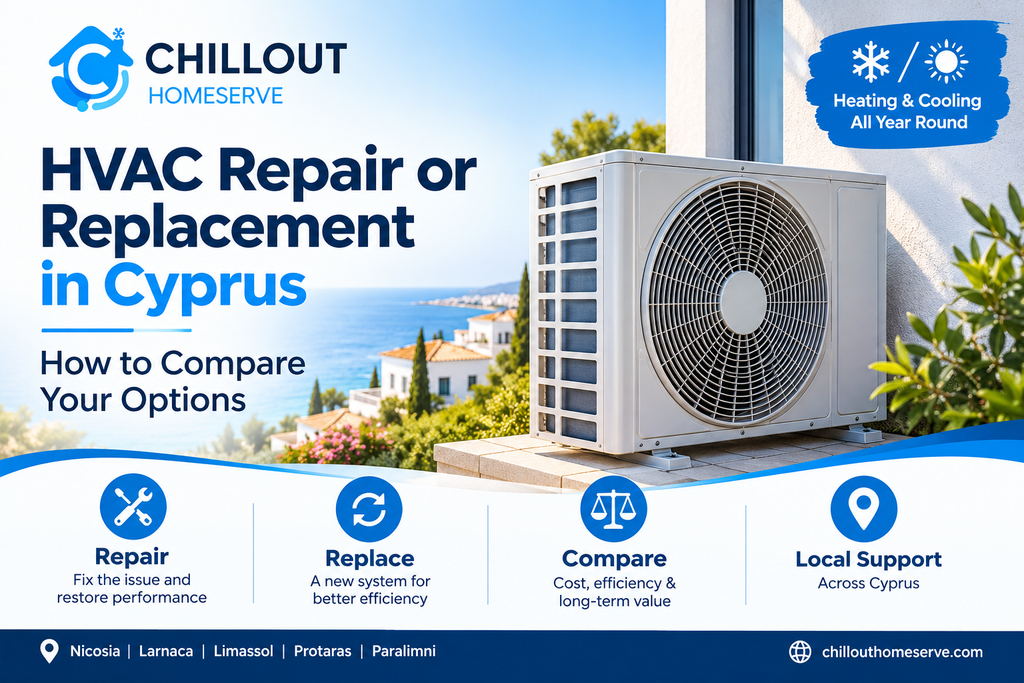
HVAC repair involves identifying faulty components and restoring equipment operation. Replacement involves removing existing equipment and installing a suitable new system.
The appropriate option depends on the condition of the installation rather than its age alone.
When Is HVAC Repair a Suitable Option?
Repair may be appropriate when the system remains in reasonable condition and the problem involves a specific component.
Minor Electrical or Control Faults
Faulty thermostats, sensors, capacitors and electrical connections can affect HVAC operation.
Replacing an individual defective component may restore performance without requiring complete system replacement.
Electrical faults should be assessed by a suitably qualified technician.
Restricted Airflow
Dirty filters, obstructed vents and dust accumulation around coils can reduce airflow.
Cleaning and maintenance may improve performance if the main equipment remains functional.
Read more about HVAC Maintenance in Cyprus to understand how seasonal servicing supports equipment operation.
Condensate Drainage Problems
Air conditioning equipment produces condensation during cooling. This water should leave through a dedicated drainage pipe.
A blocked condensate drain or damaged connection may cause water to escape around the indoor unit.
In many cases, addressing the drainage fault is sufficient without replacing the entire system.
Individual Component Failure
A damaged fan motor, faulty sensor or worn component may require replacement.
Before proceeding, the technician should consider spare-part availability, repair costs and the condition of surrounding components.
When Should You Consider HVAC Replacement?
Replacement may become appropriate when equipment deterioration affects several components or recurring repairs become difficult to justify.
Frequent Equipment Breakdowns
Repeated faults can indicate wider deterioration within the system.
Maintenance records help determine whether previous repairs involved isolated problems or continuing equipment failure.
Increasing Energy Consumption
Older equipment may consume more electricity than newer systems providing comparable heating or cooling.
However, increased energy consumption can also result from dirty filters, poor insulation, incorrect thermostat settings or changes in usage.
An assessment should examine these factors before recommending replacement.
Limited Spare-Part Availability
Some older HVAC models have components that are difficult to obtain.
Where suitable replacement parts are unavailable, installing compatible new equipment may be a practical alternative.
Major Compressor Failure
The compressor is an important part of air conditioning and heat pump systems.
When a compressor fails, property owners should compare repair costs with equipment age, refrigerant compatibility, warranty coverage and expected remaining service life.
HVAC Repair vs Replacement: Comparing Your Options
| Factor | HVAC Repair | HVAC Replacement |
| Equipment condition | Generally functional | Extensive deterioration |
| Initial expenses | Often lower | Usually higher |
| Breakdown history | Occasional faults | Frequent breakdowns |
| Energy consumption | Existing performance retained | Potential efficiency improvements |
| Spare parts | Readily available | Existing parts difficult to obtain |
| Installation work | Usually limited | More extensive |
| Remaining service life | Depends on existing equipment | New equipment service life |
| Warranty | May cover repaired components | Depends on manufacturer and installation |
Neither option is suitable for every property. A technical assessment helps establish which approach meets the building’s requirements.
Why Property Owners Arrange HVAC Assessments
Homeowners and property managers often seek professional advice because HVAC problems are not always straightforward.
Weak airflow, uneven temperatures or water leakage may appear to indicate equipment failure. However, the underlying cause could involve maintenance, drainage, insulation or thermostat settings.
An assessment through ChillouthomeServe – HVAC and Heat Pump Services can help distinguish repairable faults from problems requiring more extensive work.
Understanding the findings allows property owners to compare expenses, expected performance and future maintenance requirements.
Who May Need HVAC Repair or Replacement Services?
Homeowners
Homeowners may experience insufficient cooling, unusual equipment noises, inconsistent temperatures or increasing electricity consumption.
An inspection helps determine whether maintenance or repairs can restore normal operation.
Landlords and Property Managers
Rental properties often have HVAC equipment used by different occupants throughout the year.
Maintenance records and periodic inspections can help landlords plan repairs and equipment replacement between tenancies.
Commercial Properties
Offices, shops and other business premises may depend on HVAC equipment for indoor temperature control.
Commercial installations may require assessments of ventilation, operating hours, equipment capacity and maintenance requirements.
Insurance-Related Investigations
When HVAC faults contribute to water damage, inspection findings and photographs may help document the affected equipment and surrounding materials.
Insurance coverage depends on individual policy conditions.
Benefits of a Professional HVAC Assessment
A structured inspection can help property owners:
- Identify the underlying equipment fault.
- Compare repair and replacement expenses.
- Understand heating and cooling performance.
- Investigate recurring equipment problems.
- Assess potential energy efficiency improvements.
- Reduce unnecessary component replacements.
- Plan future maintenance requirements.
The findings should reflect the actual equipment condition and building requirements.
Related Water and Property Problems We Can Investigate
Heating and cooling faults sometimes occur alongside unrelated plumbing and moisture concerns.
Hidden Water Leaks and Damp Problems
Moisture around HVAC equipment does not necessarily originate from the unit. Concealed water pipes, condensation and waterproofing defects may produce similar symptoms.
Hidden water leak detection can help investigate moisture behind walls and beneath floors.
Drainage Issues
Blocked condensate pipes can cause water to overflow from air conditioning equipment. Household drainage defects may require separate investigation.
Underfloor Heating Faults
Water-based underfloor heating systems can experience pressure loss, restricted circulation and manifold faults. Concealed pipe leaks may also require investigation.
Property owners experiencing repeated pressure loss can read about Boiler Losing Pressure in Cyprus.
Water Ingress Problems
Moisture entering through external walls, roofs or damaged building seals may affect indoor humidity and surrounding equipment.
Identifying the source is important before repairing damaged surfaces.
How the HVAC Repair or Replacement Process Works
Step 1: Initial Assessment
The technician reviews equipment age, reported symptoms, maintenance history and operating conditions.
Step 2: System Inspection
Accessible filters, coils, fans, thermostats, electrical components and drainage connections are examined.
Step 3: Diagnostic Testing
Depending on the symptoms, testing may involve temperature measurements, airflow assessment and refrigerant circuit checks.
Step 4: Comparing Available Options
The findings help establish whether individual repairs, additional maintenance or equipment replacement are appropriate.
Step 5: Repair or Installation
Once the property owner selects an appropriate option, the required work can proceed according to equipment specifications.
Step 6: Performance Testing
Heating, cooling, airflow and drainage are checked following the work to assess system operation.
Local HVAC Experience and Area Knowledge in Cyprus
Cyprus experiences prolonged summer heat, which places considerable demand on air conditioning equipment.
In Nicosia, high summer temperatures can result in extended cooling operation. Coastal properties in Larnaca, Limassol and Protaras may experience humidity and salt exposure affecting outdoor components.
Seasonally occupied properties in Paralimni may also require equipment inspections before extended use.
For property-specific information, explore HVAC Service in Nicosia and Air Conditioning Repair in Nicosia.
HVAC Service Areas Covered in Cyprus
ChillouthomeServe covers the following locations:
| Location | Surrounding service areas |
| Nicosia | Strovolos, Anageia, Deneia |
| Larnaca | Aradippou, Oroklini, Kiti, Pervolia |
| Limassol | Asomatos, Apsiou, Pentakomo |
| Protaras | Kapparis, Ayia Napa |
| Paralimni | Deryneia, Sotira |
Service requirements depend on equipment type, property location and the nature of the fault.
Frequently Asked Questions
Is it better to repair or replace an HVAC system?
Repair may be suitable for equipment with isolated faults and reasonable remaining service life. Replacement may be appropriate when breakdowns become frequent, components deteriorate or repair expenses increase.
How long does an HVAC system last in Cyprus?
Many air conditioning and heat pump systems operate for approximately 10–15 years or longer. Actual service life depends on equipment quality, usage, installation conditions and maintenance.
Can an HVAC water leak be repaired without replacing the system?
Yes. Water leakage caused by blocked condensate drains, damaged drainage connections or certain airflow problems may be repairable without complete equipment replacement.
Why is my HVAC system not cooling properly?
Reduced cooling may result from dirty filters, restricted airflow, refrigerant faults, thermostat problems or damaged components. Diagnostic testing helps identify the cause.
How often should HVAC equipment be serviced in Cyprus?
An annual inspection is a reasonable starting point. Equipment used extensively during summer may benefit from additional maintenance according to manufacturer recommendations.
Does replacing an HVAC system reduce electricity consumption?
Newer equipment may consume less electricity when appropriately sized and installed. Actual savings depend on usage patterns, insulation, thermostat settings and equipment efficiency.
Can uneven room temperatures be corrected through HVAC repair?
Yes. Uneven temperatures may result from airflow restrictions, thermostat faults or ventilation problems. Read more about HVAC Service in Nicosia for Uneven Room Temperatures.
Conclusion
Choosing between HVAC repair and replacement in Cyprus requires understanding equipment condition, maintenance history, repair expenses and expected future performance.
Individual faults can often be addressed through appropriate repairs, while deteriorating equipment may require replacement.
ChillouthomeServe provides heating, cooling, plumbing and related property maintenance services across Cyprus.
If your equipment experiences recurring breakdowns, reduced cooling, water leakage or inconsistent heating, visit ChillouthomeServe to discuss an appropriate system assessment.