
Property maintenance Pipe Route Tracing often comes down to knowing exactly what lies behind your walls and beneath your floors. For many building owners, the complex network of utility lines remains entirely invisible until a renovation project begins or a hidden fault develops. Knowing the precise path of your plumbing and electrical networks saves time, reduces unnecessary excavation, and prevents accidental damage to critical infrastructure.
When dealing with complex structural layouts, especially in older builds or modern villas with extensive underfloor systems, finding a reliable specialist is essential. While a property owner might quickly search for an electrician near me to handle obvious wiring faults, mapping sub-surface utilities requires a distinct, specialized approach. In Cyprus, where construction methods heavily rely on concrete, stone, and embedded conduits, precision mapping through professional pipe route tracing is the most effective way to safeguard your investment.
What is Pipe Route Tracing?
Pipe route tracing is a non-destructive diagnostic method used to locate and map the exact path of underground or hidden metallic and non-metallic pipes. Instead of relying on guesswork or old architectural blueprints—which are frequently outdated or inaccurate—technicians use specialized electromagnetic locators, signal transmitters, and ground-penetrating frequencies to trace utility lines.
The process identifies the depth, direction, and layout of buried networks without breaking into concrete slabs or tearing down plasterboards. It provides a clear visual map of where utilities run, allowing subsequent repair or construction work to proceed safely.
Why Property Owners Seek Professional Diagnostic Services
Many modern plumbing lines run alongside electrical conduits, especially in centralized utility shafts or underfloor distribution manifolds. When a homeowner searches for a trusted electrical technician or an electrician near me during a renovation, it is often because they realize that cutting into a wall blindly poses a significant safety risk.
Electrical systems and water networks are deeply interconnected within a building’s structure. Accidentally drilling into a hidden water main can flood electrical conduits, leading to short circuits, system failures, and severe structural hazards. Engaging a specialist to accurately trace utilities ensures that subsequent electrical, plumbing, or structural work happens without cross-damaging other systems.
Who Needs This Service?
Hidden utility mapping serves a wide range of property owners and professionals across the region. It is particularly valuable for:
- Homeowners: Planning extensions, kitchen remodels, or installing new fixtures without puncturing hidden lines.
- Landlords & Property Managers: Maintaining older rental units where original plumbing layouts are unknown, or tracking down ongoing maintenance issues.
- Commercial Properties: Managing large-scale complexes, office buildings, or retail spaces with complex, heavy-duty utility networks.
- Insurance Investigators: Documenting structural faults or sourcing the exact origin of water damage to support legitimate claims.
Systems Evaluated During Investigation
Specialized tracing equipment can identify and map several critical concealed systems:
- Hidden Leaks: Pinpointing the exact path of a leaking line to minimize the area of repair.
- Damp Problems & Water Ingress: Tracking how moisture moves through structural walls or foundations from hidden pipe pathways.
- Drainage Issues: Locating blocked or collapsed subterranean drainage lines beneath concrete driveways or garden areas.
- Underfloor Heating Faults: Mapping out the intricate loops of underfloor heating systems before floor tiles are lifted or replaced.
Benefits of Professional Utility Mapping
Investing in accurate route tracing offers long-term protection for any building. The primary advantages include:
- Damage Prevention: Eliminates the risk of striking high-pressure water mains or live electrical lines during excavation or drilling.
- Cost Efficiency: Minimizes destruction. Instead of digging up an entire room to find a pipe, technicians identify the exact point that requires attention.
- Accurate Planning: Provides dependable data for architects, structural engineers, and contractors before any physical work begins.
- Time Savings: Reduces project delays by removing the trial-and-error aspect of locating utility lines.
How the Process Works
Professional tracing relies on systematic, non-invasive technology tailored to the specific material of the pipe.
1. Initial Assessment and Signal Introduction
For metallic pipes, a low-frequency electromagnetic signal is applied directly to an accessible valve or meter using a transmitter. For non-metallic pipes (such as PVC or PEX), a traceable flexible probe or sonde is inserted into the line through an access point.
2. Detection and Tracing
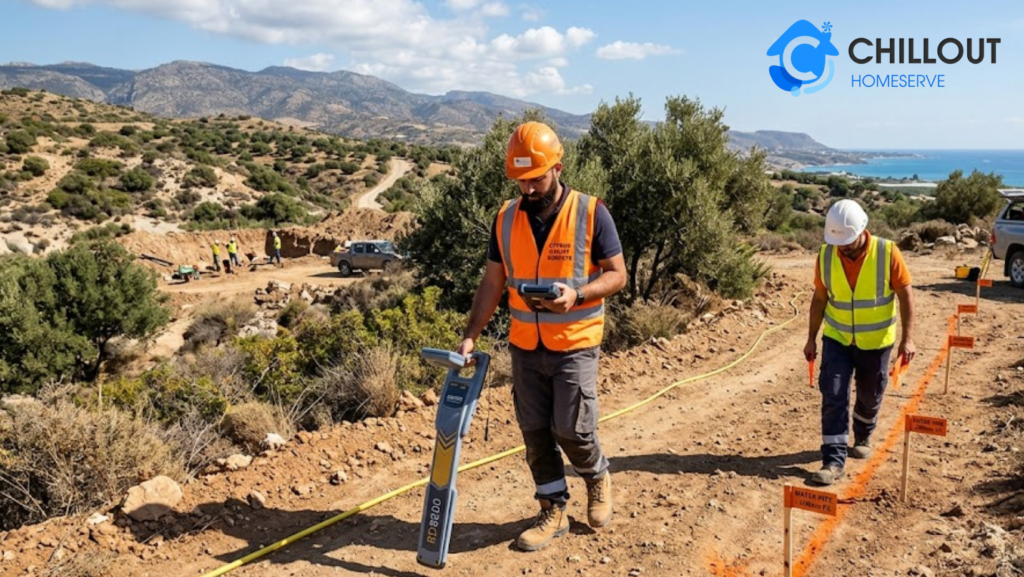
The technician moves a receiver across the surface of the floor or wall. The receiver detects the signal emitted from the pipe or probe below, indicating its exact path and approximate depth.
3. Marking and Documentation
The path is marked clearly on the surface using temporary, non-staining indicators. For larger projects, the data can be transferred onto a digital schematic for future reference during construction.
Local Experience and Structural Challenges in Cyprus
Buildings in Cyprus present unique structural characteristics that demand localized expertise. Older stone houses in historic villages, mid-century brick apartments in urban centers, and concrete frame villas all handle utilities differently.
Due to the widespread use of solid concrete slab foundations and brick partition walls finished with thick plaster, utilities are almost always embedded deeply within the structure. Furthermore, older properties rarely possess reliable as-built drawings. Seasonal temperature swings also cause structural movement, which can stress hidden lines over time. Local knowledge ensures that the correct frequencies and diagnostic methods are selected based on the specific building materials common to the region.
Service Areas Covered
Reliable utility mapping and diagnostic services are available across key regional hubs, ensuring prompt response times for both emergency investigations and planned projects:
- Nicosia: Serving commercial offices, historic residential quarters, and expanding suburban districts.
- Larnaca: Providing support for coastal properties, residential developments, and commercial structures.
- Limassol, Paphos, and the Famagusta District: Delivering comprehensive subsurface investigations for homes, hotels, and managed apartments.
Conclusion
Knowing the layout of your property’s infrastructure prevents costly mistakes, protects structural integrity, and streamlines maintenance work. Whether you are dealing with persistent dampness, preparing for a major structural renovation, or coordinating detailed electrical upgrades with a professional team, mapping your utilities is the initial step toward a successful project. Relying on professional diagnostics ensures your property remains safe, organized, and structurally sound for years to come.
Frequently Asked Questions
Can you trace plastic or PVC water pipes?
Yes. While plastic pipes do not conduct electrical signals naturally, technicians insert a specialized traceable wire or sonde into the line. This allows the receiver to detect the path of the non-metallic pipe accurately.
How accurate is the depth measurement during tracing?
Modern locating equipment is highly precise, often determining the depth of a utility line within a few centimeters. However, accuracy can be influenced by surrounding soil conditions, structural reinforcement bars (rebar), or closely packed adjacent utilities.
Will the tracing process cause any damage to my floors or walls?
No. The entire process is completely non-destructive. Signals are sent through existing access points or scanned from the surface, meaning no drilling, cutting, or digging is required to locate the lines.
Why should I trace pipes before fixing an underfloor heating issue?
Underfloor heating systems consist of tightly spaced, continuous loops of piping. Drilling into a floor to repair a separate issue without mapping these loops first can easily rupture a heating line, leading to an expensive and complex structural repair.